3d drawing and rendering in multimedia
3D rendering is the 3D computer graphics process of converting 3D models into 2d images on a computer. 3D renders may include photorealistic effects or not-photorealistic styles.
Rendering methods [edit]
Rendering is the terminal process of creating the actual 2D image or animation from the prepared scene. This can be compared to taking a photograph or filming the scene after the setup is finished in real life.[ane] Several different, and often specialized, rendering methods accept been developed. These range from the distinctly non-realistic wireframe rendering through polygon-based rendering, to more advanced techniques such every bit: scanline rendering, ray tracing, or radiosity. Rendering may take from fractions of a second to days for a single image/frame. In full general, different methods are better suited for either photorealistic rendering, or real-time rendering.[2]
Existent-time [edit]
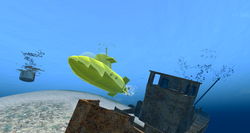
Rendering for interactive media, such as games and simulations, is calculated and displayed in real time, at rates of approximately 20 to 120 frames per second. In real-time rendering, the goal is to show as much data every bit possible as the eye can process in a fraction of a second (a.yard.a. "in one frame": In the case of a 30 frame-per-2d blitheness, a frame encompasses one 30th of a second).
The master goal is to attain an as high as possible degree of photorealism at an adequate minimum rendering speed (usually 24 frames per 2nd, equally that is the minimum the human eye needs to see to successfully create the illusion of move). In fact, exploitations can be practical in the manner the centre 'perceives' the world, and as a outcome, the concluding image presented is not necessarily that of the existent world, just one close enough for the human center to tolerate.
Rendering software may simulate such visual effects as lens flares, depth of field or motion blur. These are attempts to simulate visual phenomena resulting from the optical characteristics of cameras and of the human being center. These furnishings can lend an element of realism to a scene, even if the effect is but a imitation artifact of a camera. This is the basic method employed in games, interactive worlds and VRML.
The rapid increment in reckoner processing ability has allowed a progressively higher degree of realism even for real-fourth dimension rendering, including techniques such as HDR rendering. Existent-fourth dimension rendering is frequently polygonal and aided by the computer's GPU.[3]
Non real-fourth dimension [edit]

Animations for non-interactive media, such as feature films and video, tin take much more than time to return.[iv] Non real-time rendering enables the leveraging of limited processing power in guild to obtain higher image quality. Rendering times for individual frames may vary from a few seconds to several days for circuitous scenes. Rendered frames are stored on a hd, so transferred to other media such as motion picture film or optical disk. These frames are so displayed sequentially at loftier frame rates, typically 24, 25, or 30 frames per second (fps), to accomplish the illusion of movement.
When the goal is photo-realism, techniques such equally ray tracing, path tracing, photon mapping or radiosity are employed. This is the basic method employed in digital media and artistic works. Techniques have been developed for the purpose of simulating other naturally occurring effects, such as the interaction of lite with various forms of matter. Examples of such techniques include particle systems (which can simulate rain, smoke, or fire), volumetric sampling (to simulate fog, dust and other spatial atmospheric effects), caustics (to simulate low-cal focusing by uneven light-refracting surfaces, such equally the low-cal ripples seen on the bottom of a pond puddle), and subsurface handful (to simulate low-cal reflecting inside the volumes of solid objects, such as homo skin).
The rendering procedure is computationally expensive, given the circuitous variety of physical processes existence simulated. Computer processing power has increased speedily over the years, allowing for a progressively higher degree of realistic rendering. Movie studios that produce computer-generated animations typically brand use of a render farm to generate images in a timely manner. However, falling hardware costs mean that it is entirely possible to create small amounts of 3D animation on a home reckoner system given the costs involved when using render farms.[5] The output of the renderer is often used every bit just one small part of a completed movement-picture scene. Many layers of material may be rendered separately and integrated into the final shot using compositing software.
Reflection and shading models [edit]
Models of reflection/scattering and shading are used to draw the advent of a surface. Although these bug may seem like issues all on their own, they are studied nearly exclusively within the context of rendering. Modern 3D computer graphics rely heavily on a simplified reflection model called the Phong reflection model (not to be confused with Phong shading). In the refraction of light, an of import concept is the refractive index; in almost 3D programming implementations, the term for this value is "index of refraction" (normally shortened to IOR).
Shading can be cleaved down into two different techniques, which are often studied independently:
- Surface shading - how low-cal spreads across a surface (generally used in scanline rendering for real-fourth dimension 3D rendering in video games)
- Reflection/scattering - how light interacts with a surface at a given point (mostly used in ray-traced renders for non existent-fourth dimension photorealistic and artistic 3D rendering in both CGI even so 3D images and CGI non-interactive 3D animations)
Surface shading algorithms [edit]
Popular surface shading algorithms in 3D computer graphics include:
- Flat shading: a technique that shades each polygon of an object based on the polygon'south "normal" and the position and intensity of a low-cal source
- Gouraud shading: invented by H. Gouraud in 1971; a fast and resource-witting vertex shading technique used to simulate smoothly shaded surfaces
- Phong shading: invented by Bui Tuong Phong; used to simulate specular highlights and smooth shaded surfaces
Reflection [edit]
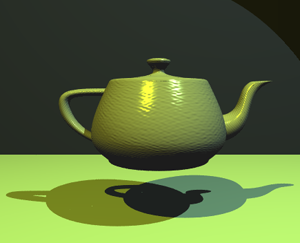
Reflection or scattering is the relationship betwixt the incoming and outgoing illumination at a given point. Descriptions of scattering are unremarkably given in terms of a bidirectional handful distribution function or BSDF.[vi]
Shading [edit]
Shading addresses how different types of handful are distributed across the surface (i.eastward., which handful function applies where). Descriptions of this kind are typically expressed with a program called a shader.[seven] A uncomplicated example of shading is texture mapping, which uses an image to specify the diffuse colour at each point on a surface, giving it more apparent detail.
Some shading techniques include:
- Bump mapping: Invented by Jim Blinn, a normal-perturbation technique used to simulate wrinkled surfaces.[8]
- Cel shading: A technique used to imitate the expect of hand-drawn blitheness.
Ship [edit]
Transport describes how illumination in a scene gets from one place to another. Visibility is a major component of lite transport.
Projection [edit]

The shaded three-dimensional objects must be flattened then that the brandish device - namely a monitor - tin can display it in only ii dimensions, this process is called 3D projection. This is done using projection and, for most applications, perspective project. The basic thought backside perspective projection is that objects that are farther away are made smaller in relation to those that are closer to the eye. Programs produce perspective past multiplying a dilation abiding raised to the power of the negative of the altitude from the observer. A dilation constant of 1 means that there is no perspective. High dilation constants tin can crusade a "fish-center" event in which image distortion begins to occur. Orthographic projection is used mainly in CAD or CAM applications where scientific modeling requires precise measurements and preservation of the third dimension.
Rendering engines [edit]
Render engines may come together or be integrated with 3D modeling software only at that place is standalone software every bit well. Some render engines are uniform with multiple 3D software, while some are exclusive to one.
See also [edit]
- Architectural rendering
- Ambient apoplexy
- Figurer vision
- Geometry pipeline
- Geometry processing
- Graphics
- Graphics processing unit (GPU)
- Graphical output devices
- Epitome processing
- Industrial CT scanning
- Painter's algorithm
- Parallel rendering
- Reflection (estimator graphics)
- SIGGRAPH
- Volume rendering
Notes and references [edit]
- ^ Badler, Norman I. "3D Object Modeling Lecture Series" (PDF). Academy of Northward Carolina at Chapel Hill. Archived (PDF) from the original on 2013-03-19.
- ^ "Not-Photorealistic Rendering". Knuckles University . Retrieved 2018-07-23 .
- ^ "The Science of 3D Rendering". The Institute for Digital Archæology . Retrieved 2019-01-19 .
- ^ Christensen, Per H.; Jarosz, Wojciech. "The Path to Path-Traced Movies" (PDF). Archived (PDF) from the original on 2019-06-26.
- ^ "How render farm pricing actually works". GarageFarm. 2021-10-24. Retrieved 2021-10-24 .
- ^ "Fundamentals of Rendering - Reflectance Functions" (PDF). Ohio State University. Archived (PDF) from the original on 2017-06-11.
- ^ The discussion shader is sometimes also used for programs that describe local geometric variation.
- ^ "Bump Mapping". spider web.cs.wpi.edu . Retrieved 2018-07-23 .
External links [edit]
- How Stuff Works - 3D Graphics
- History of Computer Graphics series of articles (Wayback Motorcar copy)
Source: https://en.wikipedia.org/wiki/3D_rendering

Postar um comentário for "3d drawing and rendering in multimedia"