catia 3d to 2d drawing
Today, the development underway for many engineering enterprises is the implementation of 3D Model Based Design (MBD), using applications such as Catia 3D Master, where all Product Manufacturing Information (PMI) such as functional tolerances, dimensions, and annotations are stored in the 3D model rather than in the linked associative 2D drawings.
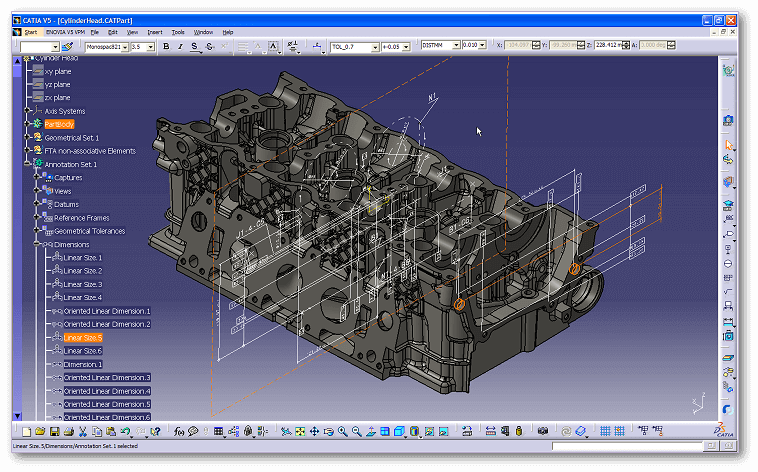
If you are implementing MBD within your company, then new 3D CAD models will exist created with 3D PMI information included from the beginning. Merely what nigh your existing CAD model data? Yous have a significant investment in existing production designs and standard parts that consist of 3D CAD models with linked 2D drawings that you want to be able to re-utilize in the MBD environment.
The re-use of existing data is not usually a priority when customers programme their MBD implementations. Even so, effective legacy data re-use is essential to accelerate adoption and demonstrate the benefits of this methodology. The first pick usually considered for information re-use is the manual remastering of legacy parts in the MBD environs with 3D PMI included. The other close choice is an engineer's estimation of the 2D PMIs in the original drawings, extracting the information, so adding the required 3D PMI entities to the original 3D model.
Yet, both of these options are expensive, labor intensive and susceptible to human being error. The endeavour required is such that i customer was considering the expense of employing a squad of contractors specifically to bargain with legacy model recreation for their new MBD environs.
As with whatever manual remastering process, there is too the serious risk of design difference and unexpected changes being introduced equally a issue of human error when interpreting data between the 2nd drawing and the 3D model by manually transferring design intent.
Conspicuously a more effective solution is needed to enable companies to migrate their existing CAD models to the MBD environment and maximize data re-use. A requirement exists for an automatic solution that tin extract the necessary manufacturing information from a 2D drawing and add it to the 3D part : DrawtoPMI, an innovative solution from ITI.
DrawtoPMI supports the migration of legacy CAD data for utilise in the MBD environment. DrawtoPMI uses the 3D CAD model and associated 2D drawing to automatically combine them into a unmarried 3D model file containing all 3D PMI information, including views, sections, functional tolerances and annotations, ready for immediate use in the MBD environment.
DrawtoPMI creates Annotation Sets in the MBD model with the 3D PMI information organized into dissimilar View Captures, each one equivalent to one of the original 2D cartoon canvass views. The MBD user tin can browse through the View Captures to review the 3D PMI information as needed.
In the example of CATIA V5, DrawtoPMI uses the CATIA API to query the associative views in the 2d cartoon. It extracts the PMI information, intelligently maps PMI entity associativity from the second drawing geometry to the advisable 3D function geometry, and automatically creates the required FT&A entities in the CATIA V5 3D Master model. By using the CAD system API to query and extract the 2d PMI data, and then to create the 3D PMI entities in an automated process, any design intent deviation due to human interpretation errors have been eliminated.
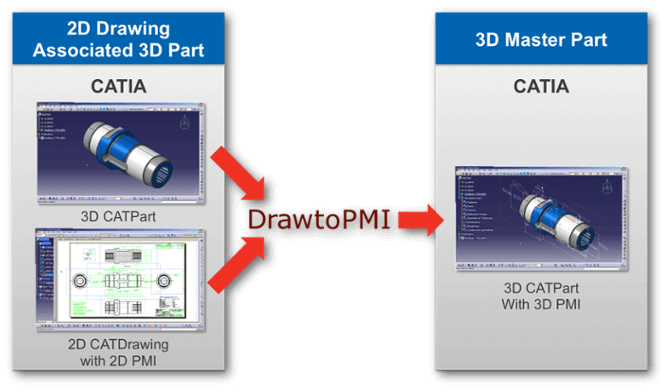
DrawtoPMI automated legacy data migration for Catia 3D Master
DrawtoPMI will as well transfer non-associative dimensions in lodge to to drift the entire 2nd environment in the MBD model. The power to create non-associative 3D PMI entities too allows DrawtoPMI to handle any incompatibility issues. If any non-associative 3D PMI entities are created in the resulting MBD model the user can decide whether to complete or reattach dimensions to the 3D geometry, using the DrawtoPMI Completion Sorcerer to guide them.
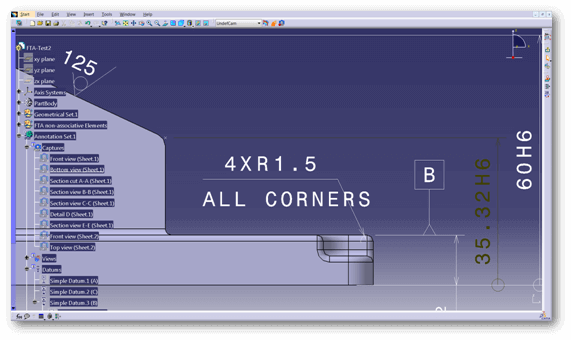
Not-associative dimensions from the second drawing are preserved, and displayed in a darker colour to warning the user
The DrawtoPMI process can take anywhere from a few seconds to a few minutes, depending on the complexity of the source data. By automatically combining legacy 3D parts and 2D drawing files, DrawtoPMI can save months of manual work and provides a convincing return on investment. One leading automotive manufacturer was faced with the chore of migrating a complex powertrain component that included six cartoon sheets, 58 associative views and over i,000 dimensions. The transmission endeavour to recreate the PMI data in the 3D function was estimated to exist at least three weeks. DrawtoPMI transferred the PMI data to the MBD model automatically in less an hour, with an additional 2 hours manual review and completion.
DrawtoPMI is an essential tool for any company implementing a Model Based Blueprint surroundings. It enables the fast and efficient migration of legacy data and eliminates the need for expensive, error-prone manual migration processes. DrawtoPMI speeds up implementation of MBD, facilitates adoption, and helps faster realize the benefits of such deployment in your organization.
Source: https://www.cadinterop.com/en/your-needs/mbd-mbe-approach/catia-migration-for-3d-master-environment.html

Postar um comentário for "catia 3d to 2d drawing"